Unlock an additional 21% off your first order.
By signing up, you agree to receive marketing emails. Unsubscribe anytime. See our Privacy Policy.

This guide is for educational purposes only and does not replace personalized medical advice from a licensed healthcare professional. These statements have not been evaluated by the FDA. This product is not intended to diagnose, treat, cure, or prevent any disease.
Lithium is a naturally occurring element
On its own, pure elemental lithium is too reactive to be practical. It must be stabilized before it can be safely manufactured, stored, and consumed, so lithium is usually paired with another molecule to form a stable compound called a lithium salt.
The molecule that lithium bonds with determines the salt's stability, how easily the body absorbs it, and how much elemental lithium is delivered per dose, which all ultimately determine its intended use.
Common examples include:
Lithium orotate is one of those salts. It combines lithium with orotic acid and acts as a delivery form for very small amounts of lithium.
Litihum orotate is stable and bioavailable, leading to it's use in dietary supplements.
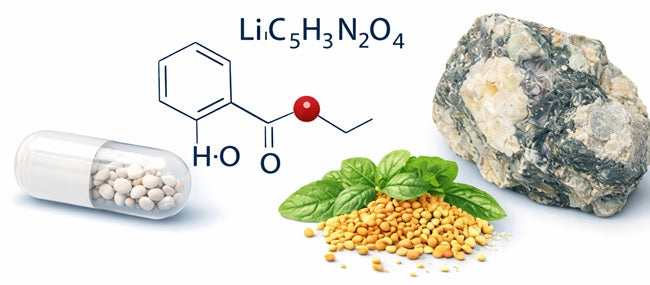
Lithium is naturally present in trace amounts in the environment and food sources.
Sometimes. Certain forms of lithium are used as prescription medications, most commonly lithium carbonate and lithium citrate.
However, prescription lithium is used at much higher doses and is managed under medical supervision. People taking prescription lithium carbonate/citrate need regular blood level monitoring, along with kidney and thyroid testing.
Lithium orotate is different. It is used as a dietary supplement and provides much smaller amounts of elemental lithium than prescription lithium products.
Lithium orotate is not equivalent to prescription lithium and should not be used as a replacement for medical treatment.

Mentaid contains 5mg of lithium orotate.
Lithium orotate is not 100% lithium. Because lithium orotate is a compound made from lithium and orotic acid, only a small portion of the total weight (milligrams) comes from elemental lithium.
Lithium orotate is approximately 3.8–4% elemental lithium by weight.
That means 5mg of lithium orotate provides about 0.2mg or 200 micrograms of elemental lithium.

Lithium orotate is generally considered safe.
A peer-reviewed toxicology study found it has been "marketed for decades as a supplemental source of lithium with few recorded adverse events." 2
Another peer reviewed source notes " there are no reported cases of death or serious side effects in more than 40 years of lithium orotate use in Europe and the U.S." 3
Another source notes "dverse effects have not been reported for low doses (lithium orotate 5 to 20 mg)." 4
For completeness, below are common side effects of prescription lithium (however again, lithium orotate is NOT a subsitute for prescription), where lithium carbonate and citrate are used at doses many times higher than any supplement. 5 They have not been documented at low supplemental doses.
A note on dosage. Side effects are dose-dependent, meaning they become more likely as the dose increases. 5

Lithium orotate typically doesn't typically cause sedation or increased alertness, so for many people, there is no single best time of day that applies to everyone and the most important factor is simply taking it consistently.
Individual responses vary. If it seems to make you feel tired, taking it in the evening may make more sense. If it seems to make you feel more alert, taking it in the morning may be better.
Lithium is processed by the kidneys, and overall hydration and kidney health can influence how the body handles it.
Use caution and consult a healthcare professional before use if you:
Mentaid is built for anyone who takes their brain aging seriously.