
Only RCTs. Only ingredients that delay cognitive decline. Here's everything that made the cut.
Two rules, no exceptions: only placebo-controlled RCTs (the highest tier of evidence), and only ingredients shown to delay cognitive decline, not just produce a short-term bump. Here's exactly what cleared that bar, and the studies behind each one.
The Breakdown
Lion's Mane
Three separate placebo-controlled trials, 12 to 49 weeks long. What stands out most: in one of them, the benefits reversed once supplementation stopped, which tells you the effect is real and active, not a fluke.
Significant improvement on a cognitive-function scale vs. placebo. Gains reversed after discontinuation.
Wiley Online LibraryImprovements across cognitive assessments, blood biomarkers, and neuroimaging vs. placebo.
Frontiers in Aging NeuroscienceSignificant improvement in cognitive scores vs. placebo.
J-StageMagnesium
The trials cover three forms (glycinate, L-threonate, and oxide), and the benefit shows up across all three. That pattern suggests what actually matters is raising blood magnesium levels, not the specific form. I chose glycinate: the largest body of evidence on efficacy and safety, added benefits for anxiety and sleep, and a price that doesn't punish you for taking it daily.
Cognitive improvement in people with existing impairment vs. placebo.
PubMedSignificant cognitive gains vs. placebo; 86% of the benefit in over-65s tracked to reduced methylation at two APOE sites, one independently linked to the strongest known genetic risk factor for Alzheimer's.
PubMedB Vitamins (B6, Folate, B12)
This is the one that actually moved the needle on brain structure, not just test scores: it slowed brain atrophy itself.
The B-vitamin group showed 30% slower brain atrophy than placebo over two years.
PubMedProtected the gray-matter regions most vulnerable to Alzheimer's, up to a 7-fold reduction in shrinkage, strongest in those with elevated baseline homocysteine.
PNASLow-Dose Lithium Orotate
The one from the next video, and the most surprising evidence in the formula. Most of psychiatry's lithium data uses lithium carbonate at psychiatric doses; this is a fraction of that dose, in the orotate form, and the human trials run far longer than anything else in this category.
Reduced cognitive decline and lowered CSF tau vs. placebo, with stability confirmed in extended follow-up.
PubMedA decade on, those originally given lithium retained substantially better cognitive and functional status.
PubMedHalved the rate of verbal-memory decline vs. placebo, one of the earliest abilities to slip with age.
JAMA NeurologyEven at a microdose, the lithium group held near baseline while the placebo group continued to decline.
PubMedMost human lithium data uses the carbonate form, so the open question was whether orotate behaves the same way. In animal studies, lithium orotate reaches comparable brain penetration to carbonate. A documented orotate overdose produced a measurable blood lithium level alongside neurological signs, confirming it does genuinely cross into the brain rather than just sitting in an unusually permeable model.
created by doctors, supported by doctors.





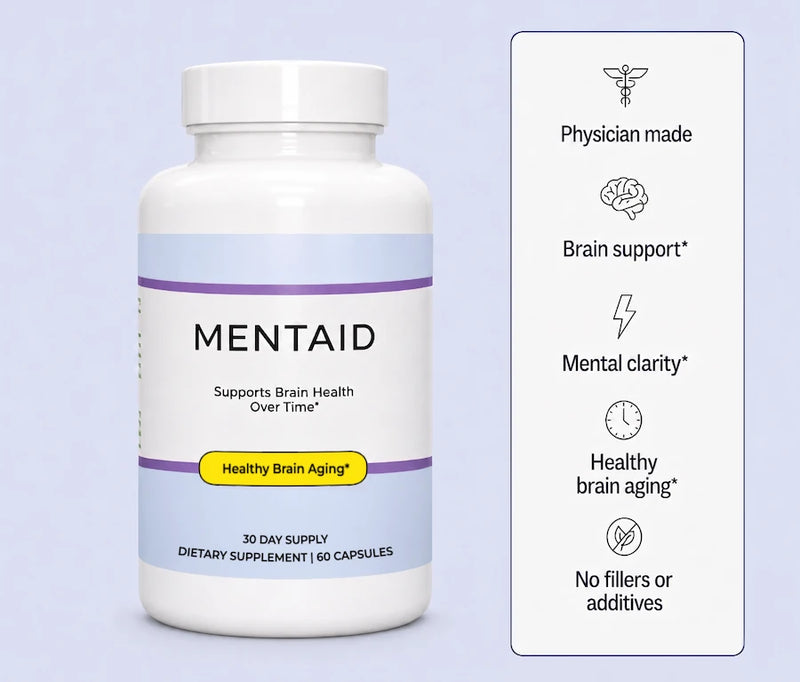

Psychiatrist-created brain health formula
- For those who feel like they're thinking through fog.*
- For those who lose their sharpness and focus by afternoon.*
- For those who feel a step slower than they used to.*
- For those who want to remain sharp as they age.*
Who Should Take Mentaid?
Anyone who's concerned about their aging brain and wants to do something about it.
Recommended Use
Take 2 capsules by mouth daily.